BRETHREN HISTORICAL REVIEW ARTICLES

Unless otherwise stated, the articles below appeared in the Brethren Historical Review (which was known as the Brethren Archivists and Historians Network Review until vol 4. no.1 (2006)). The articles are the copyright of the Brethren Archivists and Historians Network. You are free to cite the articles or make copies for educational use, but please acknowledge them in the usual way by citing the title of the journal and its volume and page number/s (the data is given at the beginning of each article).


Gyosu Albrecht, A Short History of the Brethren Assemblies in Hungary (2008). The first Brethren assemblies developed in Hungary at the beginning of the twentieth century. This unique primary source in English, written by one of their key leaders, traces their origin, development and years under Communist rule. 

David Brady, An Interview with Garrison Keillor (2000). The American humourist and novelist explains in this exclusive interview what he owes to his Brethren upbringing and makes some shrewd observations about the movement.

F. Roy Coad, Dr Daisy Dina Ronco (2009). Dr Ronco was the historian of the Italian Brethren Movement, the Churches of the Brethren (formerly the Free Italian Churches). The English Brethren historian, Roy Coad, outlines her life in this obituary. 

F. Roy Coad, Prophetic developments with particular reference to the early Brethren movement (1966). This paper, which appeared as Christian Brethren Fellowship Occasional Paper Number 2, sets the eschatological views of the early Brethren in the context of Christian history and concludes with some practical propositions on the nature of prophetic enquiry. 

Peter Cousins, Robert Stanes (1841-1932): a merchant 'son' of George Müller (2004). Robert Stanes's story contradicts the politically correct version of evangelicals in India. He was a merchant in south India who was associated with the Brethren for a while and who greatly admired George Muller. He gave away much of his wealth in imitation of his hero.

Edwin Cross, William Reid (1822-1881): a biographical sketch. William Reid was a Presbyterian minister who joined the Brethren in Carlisle and became a Brethren pioneer in Sweden. 

Neil T.R. Dickson, Evangelical historiography: an interview with David Bebbington (2005). Prof. D. W. Bebbington has written a classic account of Protestant evangelicalism in Britain. In this exclusive interview he discusses the forces shaping contemporary evangelical historiography, and the challenges it faces.

Neil T.R. Dickson, 'Shut in with Thee': the morning meeting among Scottish Open Brethren, 1840s-1960s (1999). This paper originally appeared in vol. 35 of Studies in Church History. Although the source material is drawn from the Open Brethren in Scotland, much of the paper is applicable to Brethren views of the Lord's supper in other contexts. 

Guy Featherstone, 'Holy City': the Brethren community at Kyneton, 1900-1911 (2008). A group of B.W. Newton's followers emigrated to Kyneton, Victoria, and established a religious community (known locally as the 'Holy City'). This paper describes the foundation of the community and its eventual demise  when the members set out to re-establish it in Jerusalem.

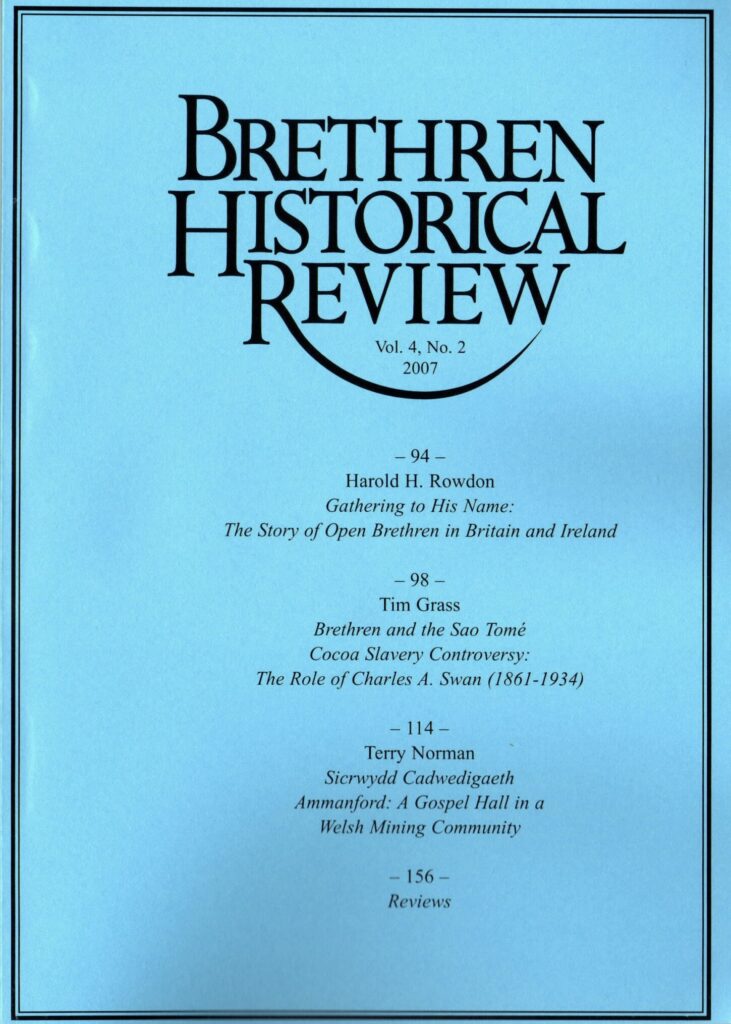
Tim Grass, Brethren and the Sao Tomé cocoa slavery controversy: the role of Charles A. Swan (1861-1934) (2007). It is a commonplace of writing on Brethren missionaries that they avoided political involvement, yet when chocolate manufacturers, Cadburys, received reports that the plantations which supplied them were being worked by what amounted to slave labour, the missionary Charles Swan played an important role in investigating the allegations.

Tim Grass, Edwin Cross (2009). Edwin Cross was an important preacher, publisher and writer among Kelly-Lowe Brethren. This obituary outlines his contribution to the Brethren movement.

Tim Grass, Thomas Dowglass (1806-57) - evangelist (2006). Thomas Dowglas is a neglected figure in Brethren history. A former army officer turned evangelist, he founded a Brethren assembly in Totnes, Devon, but then under the influence of Edward's Irving's ideas, it became an Irvingite congregation. His career shows the interest of early Brethren in charismatic phenomena, but also throws up issues surrounding their soteriology.

Timothy Larsen, 'Living by faith': a short history of Brethren practice (1998). 'Living by faith' was adopted by the Brethren founders, such as A.N. Groves, George Muller and J.N Darby. This paper shows how flexibly the principles could be applied, and examines late twentieth-century revisionist approaches to it.

Geir Lie, The ecclesiology of Gene Edwards (2006). The American preacher, church planter and writer Gene Edwards is a founder of house churches. This article traces his development and shows his indebtedness for his theology of the church to the Brethren and figures such as Watchman Nee.

Jason Lim, Assumptions and evidence: the case of Philip of Philip Robinson (1830-1886) (2004). This paper on the life of the founder of the Brethren in Singapore explodes some of the myths which have surrounded him and showing how his twin role as merchant and active church member makes him a unique person in the history of the colony.

Ian McDowell, Rice Thomas Hopkins 1842-1916: an open brother (1997). R.T. Hopkins is a neglected figure among Brethren revivalists, perhaps because of his association with the Churches of God schism and 'Hopkins Brethren' in Australia. But this paper argues he was essentially 'open' in his Brethrenism.

Dave Napier, The search for Anthony Norris Groves (2008). Anthony Norris Groves was highly influential in the foundation of the Brethren movement and was the first Brethren missionary, but where is his tomb? This paper solves the mystery.

Terry Norman, Sicrwydd Cadwedigaeth Ammanford: a Gospel hall in a Welsh mining community (2007). From South Wales to New Zealand and back, this paper traces the remarkable social and spiritual journey of William Herbert (1859-1937) and his involvement in the Welsh Revival of 1904, placing him and the assembly he founded in their social and historical context.

Ian Randall, 'Outside the camp': Brethren spirituality and wider evangelicalism in the 1920s (2000). The 1920s were a time of change for the Open Brethren. Many had made separation from the wider Christian world of central importance, yet by the end of the decade, others were increasingly willing to enter the evangelical mainstream.

Roger N. Shuff, Open to closed: the growth of exclusivism among Brethren in Britain 1848-1953 (1997).  This paper shows how open the Exclusive Brethren remained in admission to the Lord's supper while J.N. Darby was alive and how they reflected the cultural milieu of Romanticism. But, it argues, exclusivist trends grew, particularly under James Taylor Snr.

Timothy C.F. Stunt, Brethren or Philistine? (2000). Thanks partly to Edmund Gosse's Father and Son, the Brethren have for long been seen as the antithesis of Arnold's 'sweetness and light'. But scholars are now beginning to question the myth constructed by Gosse.

Timothy C.F. Stunt, John Jewell Penstone (1817-1902), his family and the Brethren (2008). J.J. Penstone was an artist, principally known for his etchings, and a member of the early Brethren. This paper examines his work in the context of his life and times, and also discusses his son, Edward Penstone, who was responsible for the portrait of J.N. Darby in the National Portrait Gallery, London. (Due to the graphics it contains, this paper may take longer to open, depending on the speed of your connection.)  

Timothy C.F. Stunt, John Nelson Darby: the scholarly enigma (2003). Darby had a wonderfully enquiring mind and kept abreast of a huge amount of contemporary learning and writing, as this paper demonstrates.

Timothy C.F. Stunt, The tribulation of controversy: a review article (2003). Dave MacPherson, author of The Rapture Plot, has been a persistent critic of J.D Darby's originality, yet his book raises serious questions about the nature of historical enquiry.

Timothy C.F. Stunt, The early development of Arthur Augustus Rees and his relations with the Brethren (2006). The subject of this paper was a former naval officer who was the minister of an independent congregation in Sunderland, but he had associations with the Brethren as well as the scandalous Henry James Prince.

Pauline Summerton, Cholmeley Evangelical Church, Highgate, London, 1884-1994: a history from a personal perspective (2000). This history of a significant north London Brethren church is by a long-term member who examines its evolution over 100 years.

Max Weremchuk, Is Darby still relevant? (2003). Some 200 years after his birth, this paper, by a biographer of J.N. Darby, commends the wisdom of Darby's attitudes and his ideas on Christian unity and ministry.

Elisabeth Wilson, Your citizenship is in Heaven: Brethren attitudes to authority and government (2003). Submission to the powers that be and separation from the world was a particulalry Brethren dichotomy. The considerable range of opinion in reconciling these opposed principles is examined in this paper with special reference to pacifism.

Elisabeth Wilson, "The eyes of the authorities are upon us": the Brethren and World War I (2004). Given their tradition of pacifism, World War I faced the Brethren with a dilemma, but it shocked them out of their insularity, showing them they could not ignore the changing world around them.


Last Updated 2009-12-08 22:00:23